The AI Race Is Leaving the Planet

SpaceX and Nvidia are putting real chips, launch dates, and infrastructure behind the race to build AI data centers in space
Listen to the audio version of this article (generated by AI).
In the fourth quarter of 2027, if Elon Musk’s timetable holds, a SpaceX (SPCX) rocket will carry a very unusual payload into orbit…
Part of an AI factory.
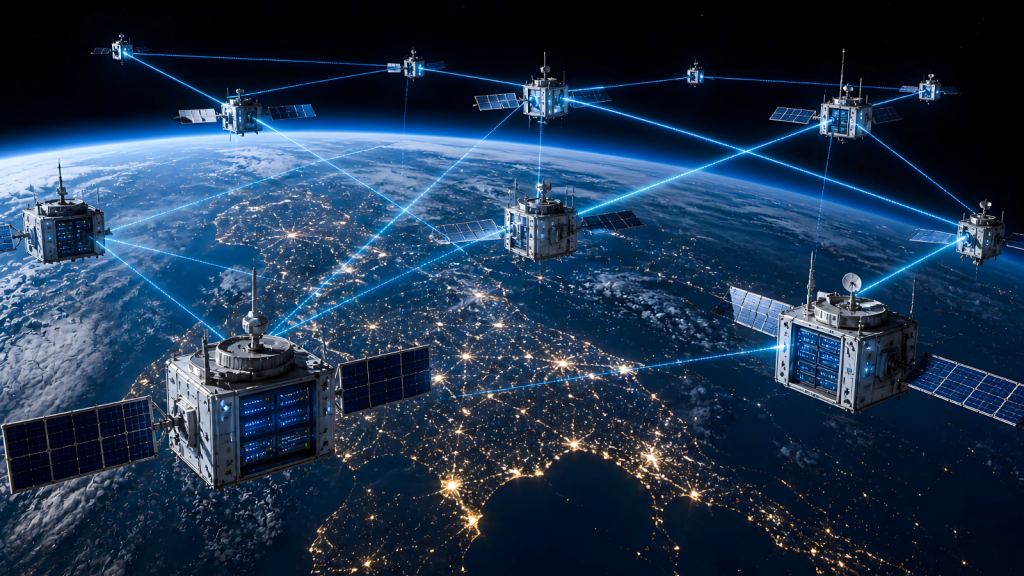
The first-generation Starmind satellite is expected to contain an optimized version of Nvidia’s (NVDA) Vera Rubin NVL72 system – the same computing architecture SpaceXAI is adopting for Grok’s data centers on Earth. SpaceX expects the orbital program to begin reaching significant scale in 2028.
Plenty can still go wrong. SpaceX has to redesign the system around radiation, heat, power, reliability, and the violence of launch. Musk is also known for his audacious targets, so the timeline may slip.
But the processor has been chosen. Engineers have a target platform. The launch window is on the calendar.
Back in April, we laid out the economic case for moving part of the AI grid into orbit. SpaceX and Nvidia are putting real hardware and a timetable behind it.
The AI race is now leaving the planet.
SpaceX Is Taking Nvidia’s AI Architecture From Earth to Orbit
SpaceX is building Starmind around the same computing platform Grok already uses on Earth.
SpaceXAI will use Vera CPUs to help Grok’s agents coordinate tools, execute code, process information, and run simulations. Its largest terrestrial AI factories will run on the full Vera Rubin platform. Then an optimized version of that architecture will fly aboard Starmind.
Nvidia describes the strategy as one computing foundation spanning enormous Earth-based data centers and orbital AI infrastructure.
That means software developed for Grok’s Earth-based systems does not have to be rebuilt from scratch for orbit. Engineers can start with the same chips, networking, and software, then redesign the hardware for radiation, launch vibration, tight power limits, and the challenge of cooling equipment in space.
SpaceX is starting with a proven AI platform and adapting it for a much harder environment.
AI Agents Could Give Space Data Centers Their First Real Market
GPUs handle the heavy mathematical work behind modern AI. Between those bursts, an agent has to decide what comes next: run code, process data, coordinate with another system, or launch a simulation.
Vera is built to speed up that surrounding work, which makes it especially useful in orbit.
Satellites already collect enormous amounts of imagery, radar readings, communications signals, and scientific data. Today, much of that data has to travel back to Earth for analysis to inform the next step.
An AI agent running beside the sensor could begin making those decisions onboard.
A satellite could scan an image, flag military movement or a wildfire, and transmit the useful intelligence instead of sending every raw pixel to the ground. A constellation could coordinate its own observations, adjust routes, or respond to changing conditions without waiting for orders from a human command center.
That gives orbital AI a practical place to start: missions where faster answers are worth more than cheaper computing.
Defense, Earth observation, autonomous spacecraft, and other time-sensitive missions can justify any premium by turning raw data into useful intelligence before it ever reaches the ground.
SpaceX Has Put a 2027 Launch Window on Starmind
SpaceX had already said Starmind could begin launching in 2027.
Musk has now narrowed that target to the fourth quarter and offered a scale year: 2028.
Treat the dates as targets, not promises.
Musk’s timelines have slipped before, from the long-delayed Roadster to Tesla’s slower-than-expected robotaxi rollout. Orbital AI poses an even tougher challenge: SpaceX has to redesign data-center-class hardware for radiation, extreme temperature swings, launch forces, and years of remote operation.
A Launch Date Forces Real Procurement Decisions
But the date still matters because it forces the program onto a real build schedule. Parts have to be ordered. Power and cooling systems have to be designed. Solar arrays, shielding, networking, software, and satellite structures all have to come together on time.
SpaceX is building the launch infrastructure for the larger vision, too.
The company recently announced plans to invest $100 billion in a new Starbase campus in Louisiana. The proposed site would span roughly 125,000 acres and eventually support thousands of Starship flights each year, with construction expected to begin in 2027 and initial launches targeted for 2029.
That facility will arrive too late to support a fourth-quarter 2027 Starmind launch if Musk’s current timetable holds.
Its true purpose is scale.
One orbital AI satellite can fly from existing facilities. A large constellation filled with heavy compute systems requires something closer to a launch factory.
SpaceX is developing both the computer and the transportation system needed to scale it.
Space Data Centers Still Cost Far More Than Earth-Based Compute
Let’s keep our feet on the ground for a moment.
Orbital compute remains expensive.
SemiAnalysis estimates that a comparable GPU cluster deployed in space today costs nearly four times as much as one deployed on Earth. Its model puts the current all-in cost at roughly $8.64 per GPU-hour in orbit, versus $2.37 on Earth.
Its base case does not put orbit on equal cost footing with Earth until around 2040, though the gap could shrink to roughly 30% by the early 2030s.
The engineering problems are real.
Cooling remains difficult. Space is cold, but there is no air to carry heat away, so orbital data centers need large radiators.
Radiation can damage chips. Hardware failures are difficult to repair. Solar arrays and batteries add mass. Launch remains the single largest upfront cost in many orbital-compute designs.
And every kilogram of shielding, networking equipment, power systems, and cooling hardware has to survive the ride uphill.
Those problems remain unsolved. What’s changed is that orbital compute now has an engineering program, a chosen processor, and a launch window working against them.
Orbital compute only needs a few high-value jobs to justify its early premium. Falling launch and hardware costs can expand the market from there.
Space Data Centers Could Open a New Market for Nvidia
For Nvidia, Starmind creates a demand that barely existed a year ago.
Every orbital Vera Rubin system represents advanced CPUs, GPUs, networking, and software sold into an entirely new physical market.
More importantly, Nvidia’s existing dominance gives it a head start.
Developers already know its tools. AI labs already build around its software. Data-center operators already understand the platform. Taking the same platform into orbit means developers do not have to learn an entirely new system.
Nvidia brings the compute platform. SpaceX brings everything else.
It supplies the rockets. Builds the satellites. Operates the Starlink communications network. Develops Grok through SpaceXAI. And now it is designing the orbital infrastructure that could run those AI workloads.
A Starmind Constellation Would Create a New Supply Chain
Turning Starmind from one satellite into a constellation would pull an entire supply chain into orbit:
- launch and spacecraft manufacturing
- radiation-tolerant electronics
- solar arrays and energy storage
- thermal-control systems
- laser communications
- autonomous operations software
- servicing and replacement infrastructure
That puts companies such as Rocket Lab (RKLB), Redwire (RDW), Microchip Technology (MCHP), and Planet Labs (PL) on the orbital-compute watchlist.
Rocket Lab combines launch with a growing space-systems business. Redwire builds space power and structural hardware. Microchip supplies radiation-tolerant electronics. Planet Labs provides the orbital data and satellite expertise that make local processing economically useful.
These companies carry very different risks, and buying them is not the same as buying SpaceX.
But each one supplies something that would have to scale if Starmind grows into a real constellation.
We mapped many of those potential suppliers in our earlier breakdown of the stocks positioned around SpaceX’s first Starmind roadmap.
The Bottom Line: Space Data Centers Now Have a Real Roadmap
Phase one of the AI buildout put chips into warehouses the size of city blocks. Phase two may strap them to rockets.
SpaceX and Nvidia are building one AI architecture that can stretch from Grok’s terrestrial data centers into orbit. AI agents give that platform a practical first job: analyze data and make decisions close to the satellites and sensors collecting it.
Earth remains cheaper. Orbit may still win the first workloads where speed, autonomy, and proximity are worth the premium.
That opens a new market for Nvidia and gives investors a fresh reason to watch the companies supplying launch, power, electronics, networking, and spacecraft hardware.
A few months ago, orbital compute was a thesis.
Now the rack has a launch window.
And the AI race is leaving the planet.