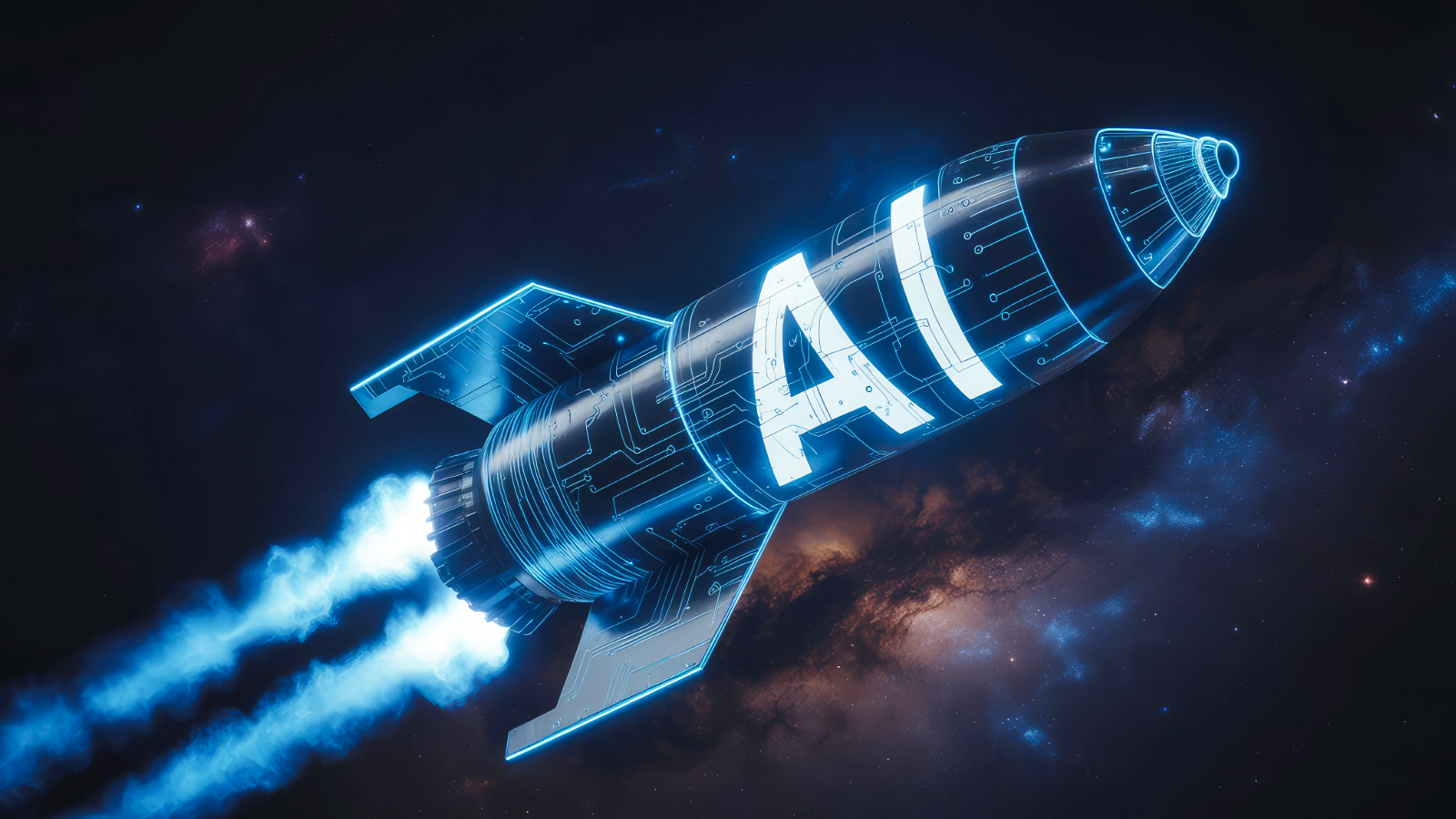
Elon Musk Says AI Will Overtake Rockets at SpaceX… This Month

SpaceX generated $2.6 billion from its AI segment last quarter – and Musk says the business is about to become larger than everything else
Listen to the audio version of this article (generated by AI).
In April 2015, Amazon.com, Inc. (AMZN) gave Amazon Web Services (AWS) its own line item on its book, just as the behemoth retailer had transformed itself into a cloud-first company.
There were murmurs, but no official heads-up from Jeff Bezos & Co. Now Elon Musk is having his AWS moment…
In a company-wide all-hands meeting last month, Musk slipped in a prediction, almost in passing, that most of Wall Street still hasn’t priced in.
SpaceX‘s (SPCX) AI revenue, he said, will exceed all of its other revenue “probably in September.”
The most famous rocket company on Earth – the one that just pulled off the largest IPO in history on the strength of its launch business and Starlink – is about to make more money from artificial intelligence than from everything else it does.
Combined.
Rockets, launch contracts, satellite internet, government missions… All of it, together, is smaller than AI. Yet, the market still prices SpaceX like a launch company with an AI side hustle.
If we’re to believe Musk, it’s the other way around.
Why Musk Thinks AI Can Become SpaceX’s Biggest Business
This trajectory is clear to see, right there in SpaceX’s first-ever public earnings report.
In Q2, total revenue surged 92% year-over-year to $7.8 billion. Impressive on its own, but dig a little deeper. The company’s AI segment grew 247% to $2.6 billion in the quarter – roughly a third of the entire business and compounding at nearly three times the pace of everything else.
Musk’s predictions are often dressed up in hyperbole. But the earnings data makes this prediction seem much less outlandish.
And the demand side is even more striking. AI darling Anthropic has agreed to pay billions per year for SpaceX’s AI compute. Google has agreed to pay SpaceX $920 million per month for access to roughly 110,000 Nvidia GPUs and related compute hardware beginning this fall. And as we detailed a few days ago, the world’s first orbital data center – Musk’s AI1 satellite – is quickly moving from concept to product, complete with a factory roadmap.
The rocket company is becoming an AI company at a pace that even the people paid to model this stuff haven’t caught up with.
SpaceX Is Becoming an AI Infrastructure Company
When SpaceX acquired xAI in a $1.25 trillion merger, most of the coverage treated it as Musk consolidating his toys. When it paid $60 billion for the AI coding agent Cursor – even more than Musk paid for Twitter – analysts scratched their heads.
But look at the pattern instead of the headlines.
AI’s growth is running into hard physical limits on Earth. Data centers need land, power, and water – and, increasingly, communities don’t want them built nearby. Space could solve all three problems at once: uninterrupted solar power, zero land requirement, and waste heat radiated directly into a vacuum.
Who owns the launch capacity to get compute into orbit? SpaceX.
Who owns the laser-linked network to move that intelligence around the planet? Starlink.
Who owns the frontier model to run on all of it? xAI.
One by one, the pieces of Musk’s empire are converging on a single product.
Intelligence – produced in massive volumes, beamed anywhere on the planet, and priced below anything competitors can easily match.
It’s the same playbook a young John D. Rockefeller ran on oil 150 years ago. Control every layer of production and distribution, drive the cost of the commodity lower, and let the economics do the conquering.
I’ve been mapping this convergence for months. And I’m convinced that what Musk is assembling is bigger than SpaceX, bigger than Tesla (TSLA) – bigger than anything he’s built before.
What Happens if AI Becomes SpaceX’s Biggest Business This Month?
Which brings us back to Musk’s prediction.
If AI overtakes everything else at SpaceX this month, investors will have to start asking a very different question about what Musk’s empire actually is. It’s not a car company, a rocket company, and a social platform that happens to share an owner, but rather a single, vertically integrated machine built to provide global intelligence.
And there’s a second date in September that I’m watching even more closely. I believe it could clear the way for Musk to take the final step in this plan… one almost nobody sees coming.
I’ll explain everything on Wednesday, September 9, at 8 p.m. Eastern, during a first-of-its-kind InvestorPlace workshop, where I’ll be joined by my colleagues Louis Navellier and Eric Fry.
We come from very different investing backgrounds, and we rarely agree on everything. But all three of us have arrived at the same conclusion about what’s forming inside Musk’s empire – and where the profits are likely to flow.
The biggest gains from what’s coming will be found in the network of roughly 3,300 suppliers and partners that Musk’s machine cannot run without – small, mostly unknown companies filling bottlenecks that no amount of vertical integration can eliminate. Historically, that’s where the truly enormous Musk-linked returns have lived. And I’ve spent months mapping exactly which of those companies matter most right now.
Next week, on Sept. 9, I’ll walk you through it all.
Reserve your spot for the event right here. It costs nothing to attend.
The rocket company is becoming an AI company this month, by its founder’s own math.
Whether you’re positioned before the market figures out what that means – that part is up to you.