The Market Isn’t Flat. It’s Rotating – And AI Is the Trigger

The market looks flat – and it has for months. The S&P 500 and Nasdaq have both spent ages drifting sideways; no breakout or breakdown, just the same sleepy story.
But that headline flatness is one of the most deceptive things happening in markets right now.
Beneath that “calm” surface, a violent, relentless – and historically unusual – rotation is underway.
On one side of the ledger: carnage.
Atlassian (TEAM), Flutter (FLUT), HubSpot (HUBS), Intuit (INTU), AppLovin (APP), Workday (WDAY), Reddit (RDDT), Zillow (Z), DraftKings (DKNG), Robinhood (HOOD), The Trade Desk (TTD), ZScaler (ZS), Pinterest (PINS), ServiceNow (NOW), Figma (FIG), Expedia (EXPE), Salesforce (CRM), SoFi (SOFI), Adobe (ADBE). Every single one of these stocks is down more than 30% in 2026. We’re barely into March. That’s not a correction. That’s a repricing.
Meanwhile…
SanDisk (SNDK), Bloom Energy (BE), Lumentum (LITE), Moderna (MRNA), Generac (GNRC), Modine (MOD), Corning (GLW), Teradyne (TER), Western Digital (WDC), Entegris (ENTG), MKS (MKSI), Vertiv (VRT), Comfort Systems (FIX). All are up more than 50% so far this year – a parabolic move higher.
These two groups are essentially canceling each other out. Hence: flat index. The headline number is hiding the truth in aggregation.
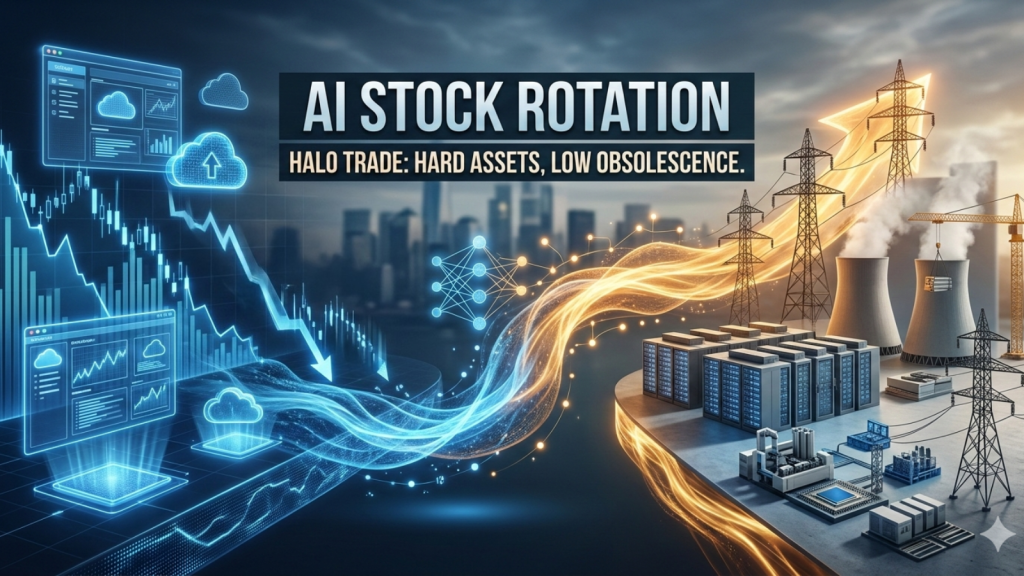
This isn’t a flat market – it’s an AI-driven stock rotation hiding in plain sight.
What separates the winners from the losers? Physical versus digital; atoms versus bits. The companies being demolished are pure-play digital – software, platforms, marketplaces, fintech apps. The companies soaring are manufacturers, hardware producers, and energy providers.
Wall Street has a name for this trade now. It’s called HALO: Hard Assets, Low Obsolescence.
And it’s the hottest trade on the Street in 2026.
AI Infrastructure Stocks: The New Market Leaders
Here’s where most of the conventional takes get it completely wrong.
Many are interpreting this rotation as evidence that the AI trade is dying. Tech is out, old economy is in. Growth is dead, value is back. Call your broker, and load up on coal companies.
That story may write itself. But it’s completely wrong.
Look at the biggest winners again. SanDisk sells AI memory. Bloom Energy provides on-site backup power for AI data centers. Lumentum sells optical components for AI networking. Vertiv builds the cooling and power infrastructure that keeps GPU clusters from melting. Comfort Systems installs the HVAC systems in the data centers housing all of that hardware.
These stocks are the physical infrastructure of AI: the wires and cooling towers and switching gear that the whole digital revolution runs on.
The AI trade isn’t dying. It’s maturing. Maturation means the market is getting far more selective about which AI stocks deserve to win.
But precision implies discrimination. And discrimination implies something far less comfortable for a lot of software businesses.
AI has become so good that it’s starting to threaten the digital economy that created it.
AI labs have recently delivered a series of leapfrog improvements – Gemini 3.0, ChatGPT 5.2, Claude Opus 4.6, Gemini 3.1 – at a pace that makes last quarter’s breakthrough feel obsolete by the next earnings call. We appear to have crossed a threshold where AI improvements are no longer incremental but compounding. And the capabilities unlocked? Truly agentic, autonomous AI; AI that doesn’t just answer questions but does things – builds software, manages workflows, writes code, runs campaigns, handles customers.
This is, plainly, an existential event for a lot of companies.
Why Software Stocks Are Getting Repriced
The tech industry spent years telling a beautiful story about AI. AI will make everything faster and smarter and better, and the companies building it will be the most profitable in history.
The market bought that enthusiastically, and a lot of software stocks went to 40x, 50x, 60x EBITDA multiples.
But there was a flip side to that pitch, which is: If AI can do everything its champions claim, it can replace everything its customers currently pay for.
That flip side has arrived.
A company can now spin up a functional customer relationship management (CRM) system using off-the-shelf large language models in an afternoon – at the cost of a few hundred dollars a year. There’s no need to shell out $50,000/year for Salesforce.
A startup can build a basic marketing automation stack with Claude Code in a day. So, why pay $10,000 annually for HubSpot’s marketing hub?
A developer can generate a reasonably functional social platform with a few hours of prompting. Why rely on Reddit’s API?
These threats are real. They are accelerating, and the market is pricing them in. When investors look at a high-multiple Software-as-a-Service (SaaS) company and ask, “will this business still be here in five years?”, the honest answer is increasingly: I genuinely don’t know. And in markets, genuine uncertainty about survival tends to compress multiples aggressively. That’s why Workday and ServiceNow are down 30%-plus. It’s why Figma – a company that was valued at $20 billion 18 months ago – is now a question mark.
Atlassian, Intuit, Adobe, The Trade Desk. These are good companies facing a suddenly credible structural threat, and the market is repricing accordingly.
Why Physical Assets Are Becoming the New Moat
At the core of this rotation is a simple asymmetry: Today, AI is primarily a digital tool. It lives in software and runs on APIs. It operates in the world of information.
What it cannot do yet – and for a long time to come – is operate in the physical world at industrial scale, low cost, or with reliable execution.
ChatGPT cannot mine copper. Claude cannot build a natural gas pipeline. Gemini cannot run a nuclear reactor, pour concrete, or install cooling systems in a data center.
This means that for the first time in about 15 years, having a physical business is a competitive advantage rather than a drag on margins. For a decade and a half, the market rewarded asset-light models – SaaS, marketplaces, platforms. Low capital requirements + high gross margins + growth = eye-watering multiples. The physical world was the slow, dumb, expensive cousin of the digital world.
Now the pendulum is swinging the other way. If your business operates in atoms – if you manufacture something, extract something, move something physical – AI is not your predator. AI is your productivity tool. It makes you more efficient, cuts your costs, helps you optimize. But it does not threaten your core reason for existing.
That’s the HALO thesis in its purest form: physical moats are the hardest moats for AI to dissolve.
HALO: Hard Assets, Low Obsolescence
Within the HALO trade, there are two distinct angles – and you want exposure to both.
HALO AI Offensive stocks are the physical picks-and-shovels of the AI buildout. These companies sell the hardware, infrastructure, and energy that AI literally cannot exist without. Think:
- Taiwan Semiconductor (TSM), whose fabrication plants represent decades of accumulated manufacturing knowledge that no competitor can replicate in under a decade.
- Vertiv, which co-engineers the cooling systems for Nvidia‘s (NVDA) latest GPU architectures and has a $9.5 billion backlog.
- Constellation Energy (CEG), whose fleet of nuclear reactors is now signing 20-year power purchase agreements directly with Microsoft (MSFT) and Meta (META) because hyperscalers need 24/7 carbon-free baseload power and there are simply not enough nuclear plants on the planet.
- Eaton (ETN), GE Vernova (GEV), Arista Networks (ANET), Micron (MU), Cameco (CCJ)…
These companies don’t just have physical moats – they have direct revenue tailwinds from AI spending. Every dollar Meta, Microsoft, Alphabet (GOOGL), and Amazon (AMZN) pour into data centers and AI infrastructure flows through these companies’ income statements. They get the best of both worlds: physical assets that can’t be disrupted plus direct beneficiary status from the same AI wave disrupting everyone else.
HALO AI Defensive stocks are the physical-world businesses using AI as a productivity tool to run their existing operations more efficiently.
- Walmart (WMT) is the canonical example. One of the world’s largest logistics networks, physical store operators, and grocery supply chains are now deploying AI to optimize demand forecasting, reduce inventory waste, and cut labor costs.
- Caterpillar (CAT) is deploying autonomous haul trucks in mining operations.
- FedEx (FDX) and UPS (UPS) are using AI route optimization to shave hundreds of millions off annual fuel and labor bills.
- Deere & Co. (DE) is embedding AI and autonomy into farm equipment so deeply that farmers are effectively locked in.
- Constellation rival Exxon (XOM) is using AI to optimize refinery operations and seismic reservoir analysis.
These stocks won’t have the explosive revenue ceilings of the offensive names. But they offer something arguably more valuable right now: genuine immunity from the AI disruption that is obliterating their pure-digital counterparts.
When the market asks, “will this business still be here in five years?,” the answer for Walmart and Caterpillar and Eaton is an almost embarrassingly confident yes.
How to Position for the AI-Driven Market Rotation
The HALO rotation isn’t a prediction or a thesis waiting for confirmation.
It’s happening right now, denominated in real stock price moves, with real institutional dollars doing the moving.
Energy is up 22% year-to-date. Materials are up 18%. Consumer staples are up 15%. The unglamorous XLE energy ETF is outperforming the Nasdaq by 25 percentage points so far this year. Caterpillar, Coca-Cola (KO), and Johnson & Johnson (JNJ) are all hitting record highs. Comfort Systems USA – a company that installs HVAC in buildings – is up 50%-plus.
Meanwhile, the “Magnificent Seven” are all in the red for the year. Every single one. And the market speaks one language fluently: price action.
There is one major caveat worth stating directly: many of these stocks have already moved. Chasing a 50% run isn’t a strategy. The smarter play is finding HALO companies – particularly in the Offensive infrastructure layer and the Defensive industrial/materials categories – that haven’t yet been fully re-rated to reflect their AI-era positioning.
There are dozens of them. The framework is the key; the specific names require homework.
The Bottom Line
The market isn’t flat. It just looks flat.
Underneath that calm surface, a generational rotation is underway, driven by a simple logic: AI is a digital tool. Digital businesses face disruption risk. Physical businesses largely don’t.
The companies selling the physical infrastructure that AI runs on are soaring. The companies operating physical-world businesses that AI can only improve – not replace – are holding up beautifully.
The pure-play digital businesses in AI’s direct path are getting taken apart.
HALO – Hard Assets, Low Obsolescence – is the trade of 2026. And given the trajectory of AI capability, which shows no signs of slowing, it will likely remain the dominant investment framework for years to come.
The market has changed – and it isn’t going back to the old regime.
Retail capital moves faster. Technology accelerates cycles. Leadership doesn’t last for years anymore. Sometimes, it barely lasts for quarters.
In that environment, buy-and-hold on its own isn’t enough.
You need to flip volatility on its head – and trade momentum instead of fearing it.
My upgraded Nexus Stock Screener identifies fast-moving trades before they go parabolic. It’s the same framework institutional traders use to find the biggest winners; and now you can, too.
In back-testing, Nexus identified eight of 2025’s top-performing stocks before their major breakouts, including:
- Hycroft Mining (HYMC) before a 1,100% move.
- Terns Pharmaceuticals (TERN) before an 865% surge.
- MP Materials (MP) months before the Pentagon deal and Apple partnership sent it soaring.
If you’re going to position for the HALO era, you need more than a thesis. You need timing – because in this market, leadership changes fast, and hesitation gets expensive.
The old playbook is fading in real time. Capital is already rotating.
Watch my new presentation to see what’s replacing it – and how to position before the next breakout wave accelerates.